Control charts: A new tool to address absenteeism
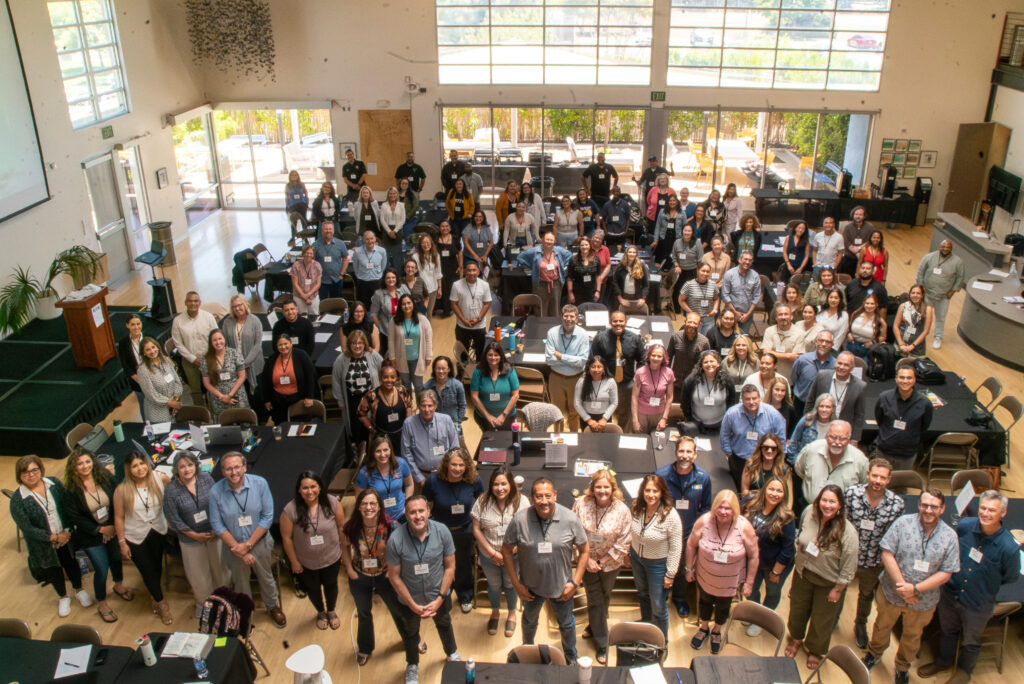
Teams from 23 school districts attended the launch of the RAISE Network seeking to use data and collaboration to reduce chronic absenteeism.
Credit: Brent Spirnak / RAISE Network
California continues to experience a chronic absenteeism crisis, with almost 1 in 5 students chronically absent across the state last year. When students miss school frequently, they risk lower academic performance and future challenges such as poverty and unemployment. Chronic absenteeism also strains school resources and disrupts learning environments.
Many of the ways we in California use data about chronic absenteeism leave educators feeling shamed or blamed when student outcomes move in the wrong direction. Too often, the data we rely on makes it hard to tell whether a change reflects something meaningful, or just normal ups and downs in a complex system.
When we can’t tell the signal from the noise, we tend to chase the wrong explanations and roll out solutions that don’t match the problem. Or we miss the moments when something truly shifts — when patterns emerge that could help us learn what’s working and where support is most needed.
Modeled on learning health networks, the RAISE Network connects 23 districts serving more than 350,000 students to learn together how to reduce chronic absenteeism. To support that learning, the network has developed tools that help California schools and districts ignore meaningless variation and focus on the data that can drive real solutions. These tools are called control charts, and they help us learn from variation. If we use them, we will no longer make these two costly mistakes:
- Overreacting to normal variation. For instance, when attendance rates dip slightly or test scores fluctuate, we may jump to blame educators, students or communities, even though these small changes are part of the system’s natural rhythm.
- Missing chances to learn from real change, such as a sharp improvement in a school’s attendance or a sudden drop in performance. These signals could uncover promising practices or reveal areas that need attention, but only if we’re looking for them the right way.
These charts matter, not because educators need another technical tool, but because they help us see the story behind the numbers. They support a shift from blame to learning, and from reaction to understanding.
Here’s the practical challenge: Even if school and district leaders want to engage in this process of learning from variation, these charts aren’t always easy to produce, interpret or share. They can feel like something reserved for researchers. So we built a tool designed to generate control charts and focus attention on what matters.
The case study generator helps users generate a series of control charts from public chronic absenteeism data, paired with guiding questions that support the process of learning from the data variation. It’s meant to help teams consider three critical aspects of the chronic absenteeism crisis:
- Make sense of the pandemic shock — and the recovery.
Teams can look across 2018-2025 and ask: How did chronic absenteeism shift from pre-pandemic patterns to the peak? Are we actually trending back toward 2018–19 norms, or have we stabilized at a new (and worse) baseline? - Compare “like” contexts to find bright spots worth studying.
Instead of comparing every school to a state average, teams can look at schools that share key features — for example, schools in the same county, serving the same grade span, with similar proportions of low-income students. That comparison isn’t about competition; it’s about learning. If one similar school shows special-cause variation, the most useful response is curiosity: What are they doing differently that we could understand, adapt and test? - Look at patterns for specific student groups over time.
Averages hide stories. When teams can view trends for student groups, they can ask: Which groups are still experiencing the highest chronic absenteeism? Which groups recovered more slowly after the pandemic peak? What barriers might be showing up here — and what supports do we need to design with students and families?
A control chart can identify meaningful variation. It cannot tell you why. That’s where the next phase of learning from variation comes in: Go and see. When a district or site identifies meaningful data, the most powerful move is to engage in a qualitative research process by visiting and listening to those experiencing the cause, and learning in context.
This process of discovering what works by learning from variation is at the heart of how RAISE is learning to improve our system. For example, this tool helped identify “bright spot” schools making meaningful progress in reducing chronic absenteeism. Our team then interviewed leaders at those sites to understand what had changed in practice. Those conversations surfaced five foundational practices — district focus, warm communication, welcoming first faces, updated student lists and supportive outreach routines — now captured in the RAISE change package and being implemented across the 23 districts in the network.
•••
Ben Sanoff is the director of data analytics at the High Tech High Graduate School of Education in San Diego and a member of the RAISE Network.
Brandon Bennett is a senior partner at the Improvement Collective, an organization that collaborates to improve outcomes for students, and a member of the RAISE Network.
The opinions expressed in this commentary represent those of the authors. EdSource welcomes commentaries representing diverse points of view. If you would like to submit a commentary, please review our guidelines and contact us.