Civics education: A call to action for California
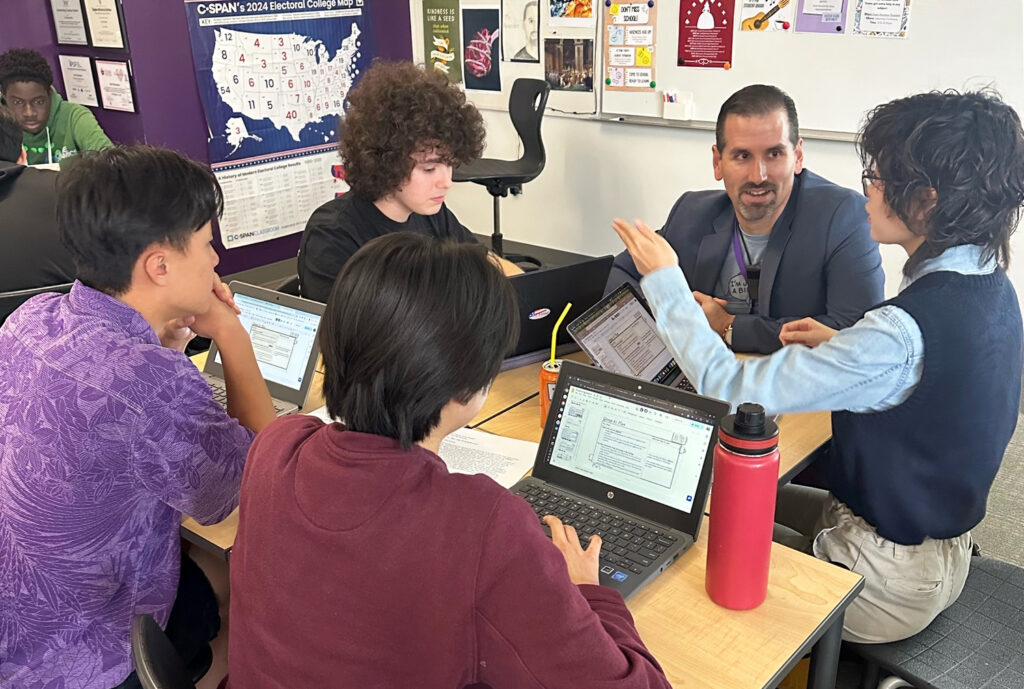
Irvine Unified teacher Jon Resendez discusses the political philosophy of the Declaration of Independence during a class at Portola High in 2024.
Credit: Kaushika (Kaushi) Palliboyina
Recently, EdSource reported that 67% of Californians believe that public schools should prioritize civic education, according to a poll conducted by the Public Policy Institute of California (PPIC).
As a civics teacher in California for the past 17 years, I would have loved that percentage to be 100%, but it was good to read that a supermajority of folks in my state value what I do.
In our current political and media climate, robust civics education is an important antidote to the rising problems of misinformation, polarization, political dysfunction and uncivil discourse.
Survey after survey shows that many Americans lack a basic understanding of civics. According to a 2024 Annenberg Public Policy Center survey, most Americans can only name one right guaranteed by the First Amendment, while about 36% of Americans cannot name all three branches of government, and only about half of American adults can identify which party controls each house of Congress.
When I see these results and the havoc they are causing in my state and beyond, it is easy to feel discouraged and wonder if, as a civics teacher, I am making any difference at all. I can’t be the only one thinking this.
California has had a government course requirement since 1987. During that time, the bicentennial celebration of the writing of the U.S. Constitution inspired many states and the federal government to create programs to support teachers to better educate students about the content and principles of the Constitution. This included the creation of the national James Madison Memorial Fellowship Foundation, in which I participated as a Fellow from California in 2012. That and serving as a Congressional Fellow in 2016 helped get me deeply involved in the practice of inspiring students to be actively engaged citizens —and helping other teachers do the same.
Next year, the nation will celebrate the 250th anniversary of the adoption of the Declaration of Independence. Sadly, we have shown little progress in educating the national electorate about the Constitution over the past 40 years. A quick stroll through the television news and social media landscape will demonstrate this.
The situation in California is just as dire as in the rest of the country, despite the adoption of statewide standards and instruction frameworks. The PPIC survey shows that only 55% of all adults in California believe that their local schools are doing an excellent or good job of preparing students to be engaged citizens.
But teaching civics well is difficult.
The first challenge is one of definition. What do we mean by civics? Does it mean ensuring students can easily recall certain basic ideas about the functioning of the American government, such as the system of checks and balances or the legislative process? Or, is civics a more immersive experience where students DO politics via collaborative activity, simulation or assignments that bring students out into their communities to observe and participate in democracy?
The answer appears to be yes and yes, which challenges civics educators to do more and probably better than their civics teachers did for them.
A second challenge comes from the fact that civics is also only engaging for students if it’s relevant and critical, but many educators shy away from controversy to avoid problems with administrators and parents. Any good effort to meet both these challenges will require resources and a team effort, including:
- Continuous opportunities to deepen learning in the content areas of history, political science, and government that are fairly compensated and respectful of each teacher’s time.
- Dedicated preparation and collaboration time to construct, equitably implement and evaluate the effect of meaningful civics experiences.
- Financial resources to take students on field trips and to bring politicians, government workers and political organizations into the classroom.
- The agency to engage the entire school community in political activities such as schoolwide decision-making, mock elections and education advocacy.
- Administrative support to manage claims from the community that a teacher is being too partisan or perhaps not exposing our students to a certain political perspective.
California has implemented excellent and well-meaning programs such as the Civic Learning Award, the State Seal of Civic Engagement and California Democracy Schools, but the effect has been limited.
Our current vision for civics is simply too trivial and narrow. Civics isn’t just about the mechanics of government; it’s fundamentally about our personal obligations to all the communities we are a part of. Our students often leave our classes knowing their civic obligations but don’t feel inspired to meet them. Civic duty requires students to engage with diverse viewpoints, especially those with which they disagree, and to learn to understand those sometimes infuriating ideas, as well as the individuals who hold them. Civics is a call to exercise compassion and tolerance in the name of “justice for all.”
American government courses of all types are valuable, and we should continue to teach them. However, I don’t believe that the rote memorization of abstract political science concepts will accomplish the civic outcomes desired by those represented in the polling data.
Civics needs to be embedded in every aspect of a student’s educational journey. It can add deeper meaning to the whole curriculum. English language arts, world languages, mathematics, science, business, visual and performing arts, and physical education all possess civic dimensions that should be explored.
To forge “a more perfect union,” the educational community in California must reflect, reallocate its resources and broaden its view of what civics is and can be. In effect, we are all civics teachers, and every class is a civics class. I call on all California educators to embrace that responsibility, and I am grateful to those who have already done so.
•••
Juan Resendez teaches civics, world history, and religions at Portola High School, in Irvine, and social studies teaching methods at the University of California Irvine.
The opinions expressed in this commentary represent those of the author. EdSource welcomes commentaries representing diverse points of view. If you would like to submit a commentary, please review our guidelines and contact us.