Charter schools in LA face literacy resource shortage
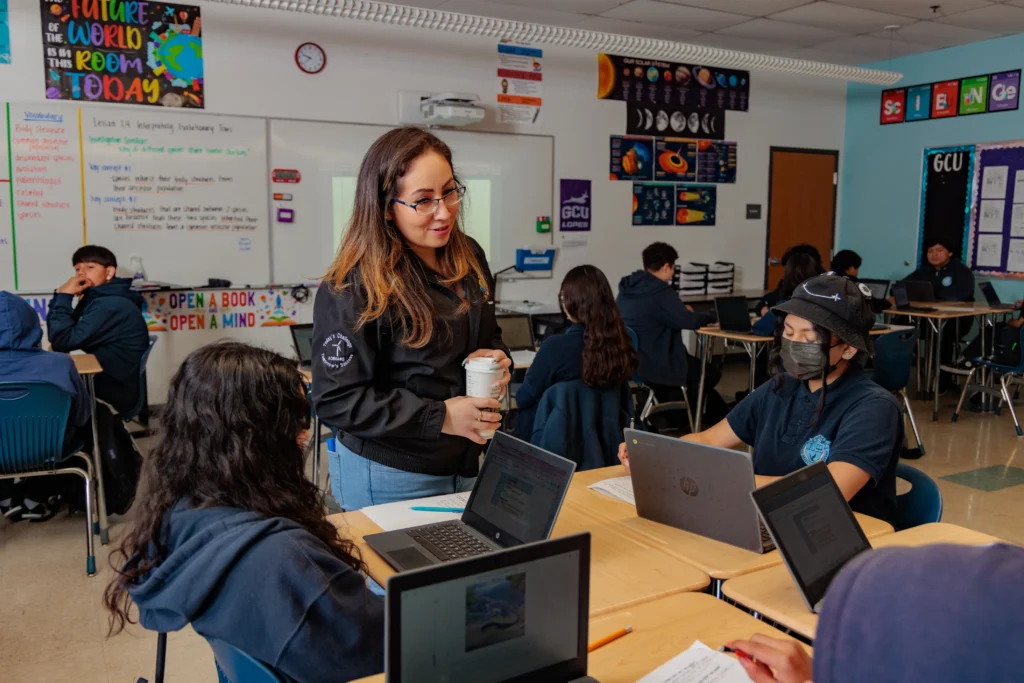
Maria Aguilera speaks to her eighth grade students.
Credit: Alliance College Ready Middle Academy
An eighth grade English learner, whom I’ll call Lupita, quietly approached me before class and asked: “Are we doing whole-class reading today? If so, please don’t call on me. I suck at reading.”
Her words broke my heart, not because she struggles with reading, but because she believes that struggling means she isn’t capable. And she is, as are all my students, even those reading below grade level.
Located in East Los Angeles, my small charter school is more than just a learning space; it’s a tight-knit community of resilient, hardworking students who dream big despite the obstacles they face. Nearly 99% of our students are Latino, and over 19% are English learners from Spanish-speaking households navigating poverty, language barriers and underfunded schools. And unlike district-run public schools, charter schools like mine operate with less per-pupil funding and fewer systemwide supports.
Like Lupita, many of my students struggle with a fundamental aspect of learning: reading. We don’t have a library, structured reading intervention programs, or literacy coaches, and we don’t have funding for books for multilingual learners or for students developing English proficiency.
“Located in East Los Angeles, my small charter school is more than just a learning space; it’s a tight-knit community of resilient, hardworking students who dream big despite the obstacles they face.”
Maria Aguilera
California’s recent state budget demonstrates that Gov. Gavin Newsom and the Legislature recognize the need for improved literacy support. The budget includes a substantial investment of $215 million to train and hire literacy coaches, as well as the initiation of supplemental English language arts/English language development instructional materials adoption, as highlighted by evidence-based literacy instruction.
However, our real challenges lie in ensuring that these vital resources reach my school and other schools like it. Additionally, we need the capacity to utilize them effectively. To enhance literacy outcomes for students in high-needs charter schools like mine, we need targeted funding and access to effective reading development tools. Here’s what we desperately require:
First, my students need books that mirror their identities, culture, language and lived experiences. When they see characters who resemble them or speak like them in stories, they are more inclined to consider themselves as readers. Unfortunately, my charter school still depends on outdated hand-me-downs or donated books that don’t reflect the world of my students.
This gap is not the result of teachers’ lack of care or commitment. Rather, it reflects the broader inequities in funding because in Los Angeles, charter schools like mine receive thousands of dollars less per student than traditional district schools, leaving us with fewer resources to meet our students’ needs. For example, in the 2019-20 school year, Los Angeles public charter schools received $5,226 less per-pupil funding than their counterparts in traditional district schools. We need money for new books like “Clap When You Land,” “Esperanza Rising” and “Murals: Walls That Sing,” or bilingual graphic novels, which are particularly engaging for students like Lupita. She brightens up when offered accessible and captivating stories; she needs narratives that draw her in, like “Invisible,” a graphic novel written by Christina Diaz Gonzalez.
Second, my students need literacy coaches. While K-3 schools in California have access to trained reading coaches or specialists who support both students and teachers, my school, which is home to middle school students, does not. (This is because grants for literacy coaches and reading specialists are allocated based on an eligible site’s enrollment in kindergarten or grades first through third, leaving out middle and high schools.) A trained literacy coach could assist my colleagues and me in applying research-based methods that directly benefit students like Lupita. For example, she finds it difficult to decode multisyllabic words and often skips entire lines when she feels frustrated. With coaching support, we could focus on these issues using structured fluency practices tailored to her current level.
Third, we also need access to instructional materials that are culturally responsive and leverage students’ strengths. This is required not only to help them catch up, but also to support their academic growth. Our students bring linguistic richness and resilience into the classroom, and literacy programs should reflect the latest research and actively engage students in both their home language and English. For example, if a student chooses to read a graphic novel, the accompanying writing prompts can guide them to respond in Spanish or English. This strategy helped Lupita write more than she had all year, transforming her self-perception from someone who “sucks at reading” to someone who has something to say, someone who has an opinion.
Lupita has made significant progress, both academically and in her confidence level, thanks in part to the learning environment in my classroom, which includes vocabulary logs with definitions, extra reading time, and chances for verbal participation. I purposely challenge my students to enhance their literacy abilities. Recently, Lupita even volunteered to read from a graphic novel during a small group session. Although she stumbled over a few words, it was clear by the end that she was proud of her accomplishment.
Supporting literacy goes beyond academics; it is a matter of justice that ensures every child has a fair opportunity for a future filled with possibilities. California must acknowledge that literacy is a right, not a privilege, and that every student, regardless of their geographic location or social status, deserves the resources to achieve it. For this to be true, the state must also ensure that charter schools, which educate thousands of California’s students, are equitably funded so our children are not left behind.
•••
Maria Aguilera, M.A., is an eighth grade science teacher and department lead in East Los Angeles and a 2025-2026 Teach Plus California Senior Policy Fellow.
The opinions expressed in this commentary represent those of the author. EdSource welcomes commentaries representing diverse points of view. If you would like to submit a commentary, please review our guidelines and contact us.