Campus Food Banks and Pantries: Your Complete Directory and Guide
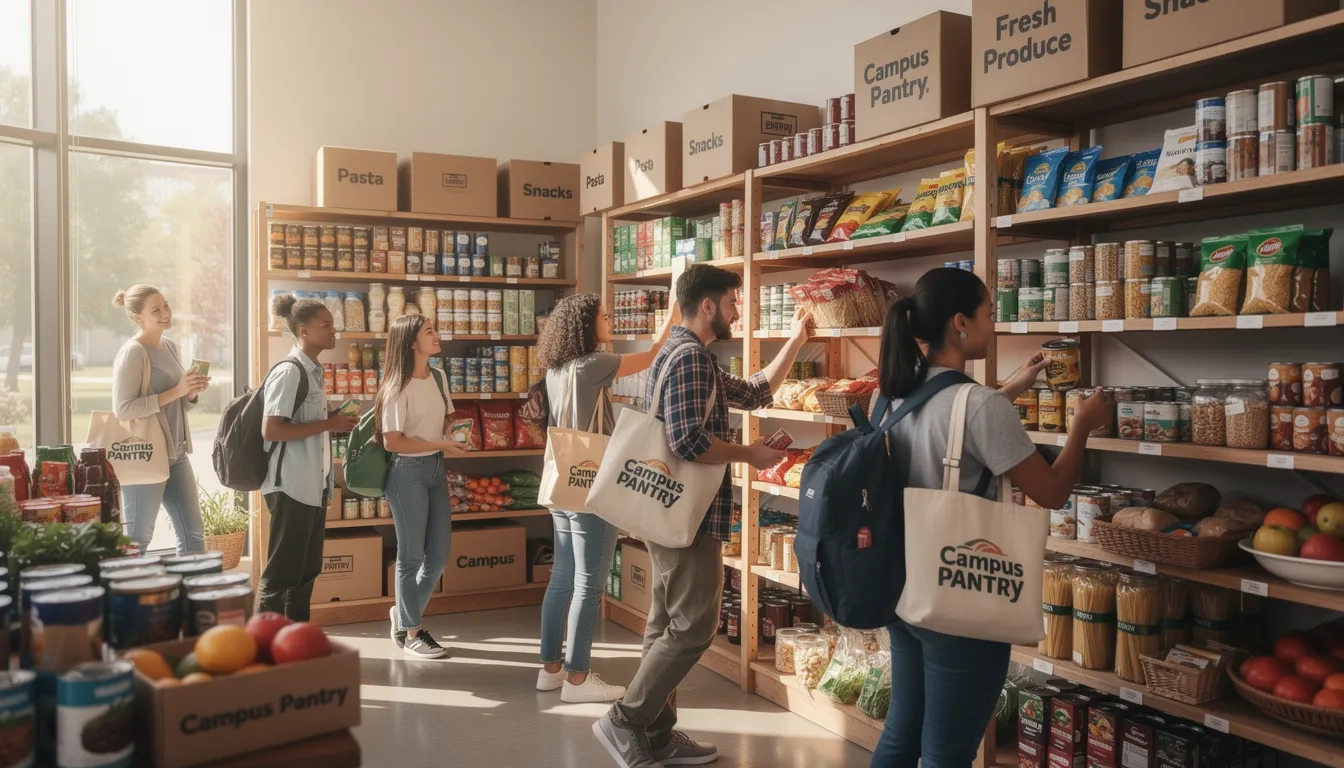
Here's a number that should stop anyone in their tracks: 67% of food-insecure college students don't know their campus offers food help. The resources are there — 95% of colleges in the U.S. now run a food pantry — but the students who need them most are often the last to find out. This guide exists to close that gap: where to look, what to expect when you get there, and what to do when the campus pantry alone isn't enough.
How Bad Is Campus Hunger, Really?
The short answer is: bad enough that every enrolled student should know these resources exist, whether they need them today or not.
The Hope Center for College, Community, and Justice surveys tens of thousands of students annually. Their data shows 41% of college students experienced food insecurity within the past month. At community colleges, that number climbs to 48%. These aren't students at struggling institutions — this is the baseline across American higher education.
The academic impact is direct and severe. Food-insecure students are 43% less likely to complete their degrees. Hunger doesn't show up only as an empty stomach; it degrades concentration, disrupts sleep, and stacks on top of financial stress in ways that ripple through grades, attendance, and eventually, whether a student finishes at all.
Who's most affected? Pell Grant recipients, students of color, part-time students, former foster youth, and students with disabilities show the highest rates. But food insecurity is more widespread than any single demographic — plenty of full-time, traditional-age students are quietly rationing meals to afford rent.
What Campus Food Banks Actually Are
Most people picture large regional food banks when they hear the term. Campus pantries are a different operation entirely.
They sit within the university itself — usually through student affairs, a basic needs office, or a student government initiative — and are built around the academic schedule. Pop-in during a break between classes, no appointment at most schools, nothing required but a student ID. In 2024, pantries across the Swipe Out Hunger network distributed over 8 million meals and 687,000 additional items, including toiletries, diapers, and appliance lending, reaching more than 766,600 students.
The range of available goods has grown well beyond shelf-stable canned goods. Seventy-one percent of campus pantries now have refrigeration units, which means fresh produce, dairy, and sometimes prepared meals. About 75% of pantries actively refer students to other on-campus resources — counseling, financial aid, housing assistance. Hunger rarely arrives without company.
Here's how campus and community pantry options compare:
| Feature | Campus Pantry | Community Food Bank |
|---|---|---|
| Who can use it | Enrolled students (sometimes staff/faculty) | Anyone in the area |
| ID required | Student ID | Varies, often none |
| Location | On or near campus | Distributed across community |
| Hours | Daytime/weekday; increasingly 24/7 via smart lockers | Varies widely |
| Extra services | SNAP help, meal swipes, referrals | Broader social services |
| Proof of financial need | Almost never required | Almost never required |
The infrastructure behind this grew fast. The College and University Food Bank Alliance (CUFBA), now folded into Swipe Out Hunger after a 2021 acquisition, helped anchor a network that now spans all 50 states.
How to Find Your Campus Food Bank
Most guides on this topic stop at "Google it." Here are more reliable paths.
Start with your school's basic needs webpage. Search "[your school name] + food pantry" or "[your school name] + basic needs office." Since roughly 2018, student advocates have pushed universities to create dedicated landing pages with pantry hours, locations, and eligibility details — most schools now have one.
For broader searches, Swipe Out Hunger (swipehunger.org) maintains the largest national directory of campus food programs. Their 2024 Campus Leader Survey covered 847 institutions, making it the most comprehensive data source available for campus-specific pantry information.
FoodPantries.org lets you search by state and county — useful when the campus pantry is off-site, or when you need a community option near where you live rather than where you study.
If you'd rather talk to a person: academic advisors, counselors, and dorm resident advisors know where the food resources are. The national helpline 211 connects callers with local food services near any zip code, around the clock, in all 50 states.
Some large university systems have built their own resource directories:
- SUNY System: All 64 State University of New York campuses have a food pantry or stigma-free food access point. The directory lives at suny.edu/foodinsecurity/campus-resources.
- University of California: The UC Basic Needs Initiative covers all 10 campuses with dedicated staff. Undergraduate food insecurity across the system hit 48% as of 2024-2025.
- CUNY System: Schools like BMCC run "Panther Pantry" operations embedded directly in student affairs.
- Community College of Philadelphia: The Food Collaborative combines pantry access, fresh produce distribution, and student policy advocacy under one program.
What to Expect When You Go
First-visit anxiety is real, and well-documented. Researchers at the Hope Center have consistently identified stigma as one of the top barriers to pantry use. Students worry about being seen, or feel they don't "deserve" the help because someone else has it worse.
Worth stating plainly: you don't need to be in crisis to use a campus food pantry. Most require only a student ID. No income verification, no appointment, no form explaining why you need help. The design is intentional — keep the barrier low, remove the shame, let students decide for themselves.
Forty percent of pantry users visit every week. These programs are a regular, practical part of how hundreds of thousands of students manage their food budgets, not a last resort for emergencies.
"Happiest I am all week is when I can go to the cupboard and get food for the week." — a student quoted in Swipe Out Hunger's national campus pantry survey
Smart lockers are reshaping the experience for many schools. Bunker Hill Community College's 24/7 smart locker system fulfilled 35,809 visits and distributed 95,659 pounds of food in 2024 alone. Students swipe a card at any hour, grab what they need, and leave — no staff interaction, no visible lines. SUNY Polytechnic has its own version, called "Poly Pantry." These systems exist specifically to sidestep stigma, and they work. Expect more campuses to adopt them over the next few years.
Other Food Resources for Students
The campus pantry is the starting point. Not the whole picture.
SNAP eligibility for college students is narrower than most people assume (this trips people up constantly). Full-time students between 18 and 49 generally need to meet at least one specific exemption: working 20 or more hours per week, participating in a federally funded work-study program, being a single parent enrolled full-time, or having a qualifying disability. Living on campus with a meal plan that covers more than half your meals can disqualify you.
If you do qualify, the average SNAP monthly benefit in 2024 ran around $189 per person, though it varies by household size and state. About 36% of campus pantries offer on-site SNAP enrollment assistance — that one-stop-shop approach removes a big practical obstacle.
Other options worth knowing:
- Meal swipe donation programs: Many campuses allow students to donate unused dining hall swipes into a shared pool. Eligible students draw from that pool for actual meals. Over 800 institutions have some version of this.
- Community food pantries: FoodPantries.org lists thousands of off-campus options searchable by zip code. No student enrollment required.
- Emergency meal assistance funds: Some schools maintain emergency funds through financial aid or the dean of students office that can cover grocery gift cards or meal plan add-ons. Ask directly — these aren't always well-advertised.
- Food rescue apps: Apps like Too Good To Go let users claim discounted surplus food from local restaurants and stores. Coverage has expanded in many college towns.
The Funding Reality Nobody Talks About
Here's something most students don't know, and that campus leaders are reluctant to say out loud: most campus food programs are structurally underfunded.
Two in five campuses identify donations as their primary funding source — staff payroll deductions, crowdfunding campaigns, one-time grants. Only 5% have a dedicated institutional budget line for food insecurity programs. Just 1% of campus food program leaders report having adequate administrative support. When donations slow down, pantry hours shrink, refrigeration units sit empty, and referral staff get reassigned.
The 2024 Inside Higher Ed survey of campus leaders found that 47% cited funding deficits as their biggest challenge, with staffing shortages (16%) and space limitations (11%) behind it.
My read on this: treating food insecurity as a donation-dependent charity program rather than an institutional responsibility is a structural mistake. Schools that budget for food programs the same way they budget for health centers and counseling services produce more consistent, reliable outcomes. Having a pantry and sustaining it year to year are two very different achievements.
Student advocates pushing for permanent budget allocations — not just annual food drives — are doing the more important long-term work.
Bottom Line
Campus hunger is widespread, under-recognized, and more solvable than the numbers suggest. Here's what to do:
- Find your school's basic needs webpage first. Search "[school name] + food pantry" or "[school name] + basic needs office." Most schools have a dedicated page.
- Use Swipe Out Hunger's directory (swipehunger.org) if your school's resources are hard to find — it covers 847 institutions across all 50 states.
- Check SNAP eligibility, especially if you're working 20+ hours a week or are a single parent. The 36% of campus pantries with on-site enrollment help are worth seeking out.
- Don't let stigma stop you. Forty percent of pantry users go every week. There is no threshold of hardship you have to hit first.
- Look beyond the pantry. Meal swipe programs, community food banks, FoodPantries.org, and emergency meal funds all fill gaps the campus pantry alone can't cover.
Frequently Asked Questions
Do I need to prove financial hardship to use my campus food pantry?
No. The vast majority of campus pantries require only a current student ID — no income verification, no means testing, no appointment. The intentional design is to lower the barrier as much as possible. If a pantry near you does require additional documentation, that's the exception, not the standard.
Can graduate students and international students use campus food banks?
Yes, at most schools. Graduate students are typically eligible, and international students (who often cannot access federal SNAP benefits) can usually use pantry services without restriction. Eligibility policies vary, but exclusions are uncommon. Check your school's pantry webpage or ask student affairs directly.
I thought SNAP was for low-income families — can college students actually qualify?
Some can, but the rules are stricter for full-time students aged 18 to 49. They need to meet at least one qualifying exemption: working 20+ hours per week, enrolled in a federally funded work-study program, being a single parent attending full-time, or having a qualifying disability. Campus pantries at 36% of schools offer on-site SNAP enrollment staff who can help you determine if you qualify and walk you through the application.
What if my campus doesn't have a food pantry?
Start with FoodPantries.org to find community options near your zip code. Call 211 for local social services referrals. Check whether a nearby college (especially a community college) has a pantry accessible to the public. And consider bringing it to your student government — 45% of campus pantries launched within the last five years, frequently because students organized and asked for them.
Are campus pantries actually running out of funding?
Many are at risk. Only 5% of campus programs have a dedicated institutional budget; 2 in 5 rely primarily on donations. That creates real volatility: one bad fundraising cycle can mean cut hours or shuttered services. This isn't a temporary problem — it's a structural one that institutional budget commitments, not food drives, are the only reliable fix for.
How do meal swipe donation programs work?
Students with unused dining plan swipes donate them into a shared pool (usually through an online portal or dining services office). Other students, typically those registered through the campus food bank or student affairs office, can then redeem those swipes at on-campus dining halls. Over 800 institutions have some version of this program, though the specific rules around how many swipes can be donated or received vary by school.
Sources
- 5 Things To Know About The Campus Pantry and College Hunger Landscape - Swipe Out Hunger
- The State of Student Food Insecurity in 2025 - Parcel Pending
- 39% of Colleges Rely on Donors to Address Food Insecurity - Inside Higher Ed
- How to Handle Food Insecurity as a College Student - BestColleges
- Swipe Out Hunger Acquires the College and University Food Bank Alliance
- Campus Food Resources - SUNY