California students drive education reform and advocacy
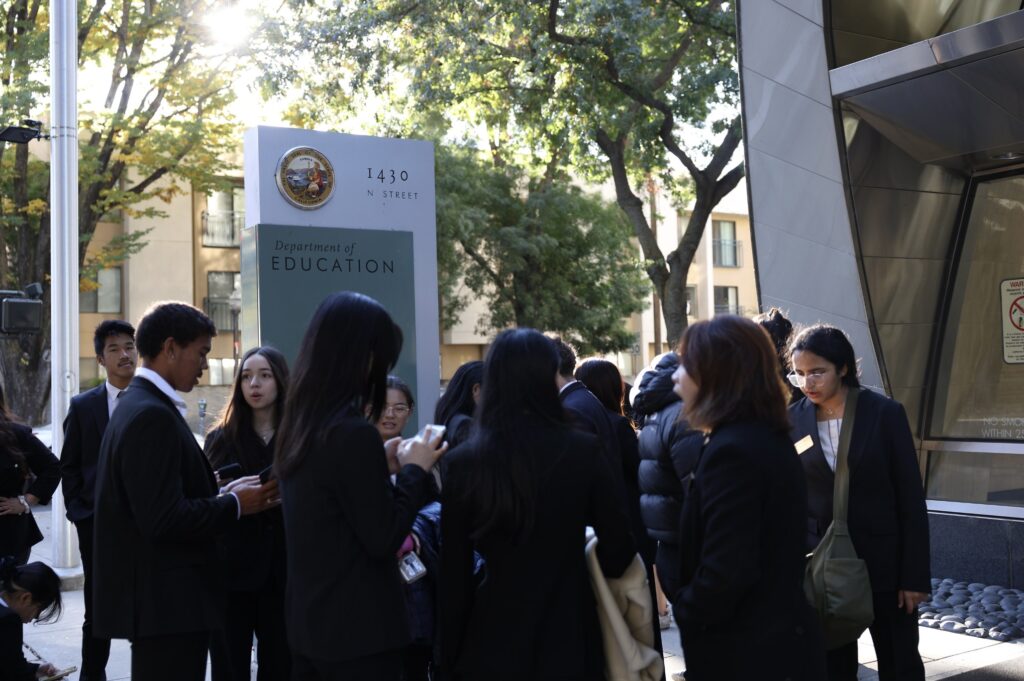
Students with the California Association of Student Councils gather at the state Capitol in support of student-led advocacy projects aimed at advancing education equity and youth representation in policy.
Credit: Muirelle Pham
When my classmate’s younger brother refused to go back to school after hearing a rumor that immigration officers were coming, I realized how fragile a student’s sense of safety can be. Most people think education policy starts in Sacramento, shaped by legislators and administrators. But often, it begins in classrooms, where students experience firsthand what is broken and decide to fix it.
Across California, students have been pushing for real reform, from access to mental health care to immigrant safety, from overlooked financial literacy to menstrual equity. It is we who notice the gaps, find solutions and rally our peers. Our voices are not peripheral; they are the foundation of genuine progress.
I helped draft a policy proposal with the California Association of Student Councils (CASC) this spring, a student-led organization that educates and empowers youth to influence education policy. We made our proposal into Assembly Bill 49, the California Safe Haven Schools Act, a law that enhances protections for immigrant families and students. It prohibits immigration enforcement within schools and bans the release of information on students without permission or by court order.
Working on AB 49 taught me that policy is not abstract, that it is built from real fears and real hope. CASC helped move the bill forward, but students carried it across the finish line. We turned fear into advocacy, insisting that safety and dignity should never depend on citizenship status. And this is not an isolated story. Student-led movements for period equity, climate sustainability and mental health support have all grown into statewide policy. When students speak, we bring urgency, empathy and firsthand insight that make legislation more effective and humane.
Regardless, structure is still essential in leadership. Students are taking on the responsibilities of policymakers, including researching, drafting and organizing, but they often do not have the authority or support commensurate to their achievements. By being active stakeholders, they can exert their influence in a way that is both practical and realistic. Nearly 1 in 4 K–12 students in California have at least one immigrant parent, meaning that education and immigration policy are not abstract debates, but daily realities for some. While students are already shaping outcomes, systems must evolve to include them from the start.
That belief guided me when I helped found Empower Health, an international nonprofit focused on health equity and policy. In both education and health care, I have seen that when young people are invited into decision-making, outcomes improve for everyone. Student voice should not be symbolic; it should be structural. Creating advisory boards with voting power, funding paid fellowships for student representatives, and requiring consultation on youth-centered legislation would make participation sustainable and fair.
Students have always been at the center of educational change, from ethnic studies to immigrant rights. The passage of AB 49 and other youth-led bills shows that youth leadership leads to more robust, compassionate policy. We no longer need to prove that student voice matters; we need systems to recognize it as a necessity.
California’s school system is at its best when it not only listens to what its students have to say, but governs with them.
•••
Muirelle Pham is a senior in Placentia-Yorba Linda Unified School District in Southern California and is involved with the California Association of Student Councils (CASC), where she contributes to student policy proposals and advocates for immigrant and underserved students.
The opinions expressed in this commentary represent those of the author. EdSource welcomes commentaries representing diverse points of view. If you would like to submit a commentary, please review our guidelines and contact us.