California colleges brace for food aid delays, offer assistance to students
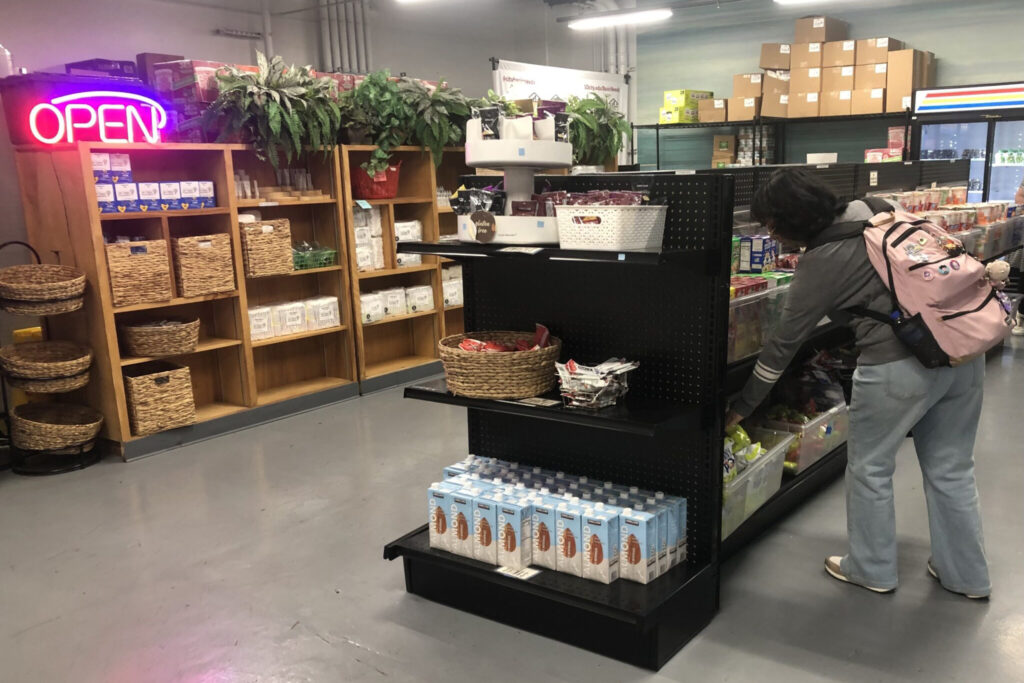
A student at San Diego City College visits the campus food pantry on Nov. 3, 2025.
Credit: Amy DiPierro / EdSource
Top Takeaways
- An estimated 330,000 students across California’s community colleges and the University of California system participate in federal food benefits through CalFresh.
- President Donald Trump’s administration said it would restart the benefits with partial payouts and warned of likely delays.
- Colleges are encouraging students to seek help from in-house emergency grant programs and food pantries.
Food assistance and basic needs programs across California’s colleges and universities braced for an influx of students on Monday in anticipation of delays to federal food benefits despite a partial last-minute reprieve.
The U.S. Department of Agriculture said it would pause funds for the Supplemental Nutrition Assistance Program (SNAP) beginning Monday because of the ongoing government shutdown. But after two federal judges ruled Friday that the freeze was likely unlawful, the White House said Monday it would pay half of the normal SNAP benefits. Federal officials also warned of potentially lengthy delays before November benefits reach the nearly 42 million Americans who receive the food aid.
The reversal will bring relief to 276,000 community college students as well as 58,400 University of California graduates and undergraduates who participate in the food benefits known locally as CalFresh, according to a 2022-23 academic year estimate by the California Policy Lab. At California State University, where more than 200,000 students qualify for federal Pell Grants, even more students are likely eligible for grocery and meal assistance.
Midmorning on Monday, Nicole Maddox worked at San Diego City College’s Knights’ Table Food Pantry. Students filed in, grabbing plastic baskets and perusing shelves lined with cans of light tuna, low-fat milk and cooked white rice. In the hallway outside, a few students heated ready-to-eat meals in a microwave. Others left with what they could carry in their hands.
The pantry was a little busier than usual, Maddox said, though students approached by a reporter said they didn’t use CalFresh. The pantry is ready for an expected crush of visitors thanks to an extra shipment of produce and other items requested from local food banks this month. “We’re receiving a lot more than we normally do to help offset whatever benefits haven’t been provided,” Maddox said.
The expected delay in SNAP payments is “heartbreaking,” she added. “We’re dealing with a vulnerable population as it is.”
In California, about 50% of college students experienced food insecurity, according to a study by the UCLA Center for Health Policy Research, meaning they had limited or uncertain access to food. But even where college students qualify for federal food benefits, they don’t always participate.
The California Policy Lab estimates that while 1 in 5 community college students are eligible for CalFresh, for example, only about a quarter of eligible students actually receive it.
CalFresh participation rates also vary widely around the state, the lab’s research found. Among community colleges, participation was highest in the Central Valley and lowest in the Bay Area. Within the UC system, almost 30% of Santa Barbara undergraduates participated in CalFresh, the most of any UC campus, while less than 17% at UCLA enrolled in the food aid program.
CalFresh can provide a significant financial cushion for college students. An analysis by the Public Policy Institute of California found that UC undergraduates and CSU students living on campus could save more than $2,100 with CalFresh benefits. A community college student living with their parents could typically gain $4,800 in disposable cash thanks to CalFresh, the analysis found.
Food pantries on two community college campuses in the Bay Area were also relatively calm on Monday. A worker at Los Medanos College in Pittsburg said there were no immediate crowds of students seeking food assistance. At Contra Costa College in San Pablo, meanwhile, small bins of potatoes and onions sat behind the counter of Compass Market, the school’s food pantry. Workers there said they see 30 to 40 students a day seeking food assistance and reported no increase in demand by midmorning from the SNAP crisis.
The market is supplied by the Food Bank of Contra Costa and Solano counties. Wall shelves were lined with canned goods, pasta, cereal, and boxes of macaroni and cheese. Students only need to show an ID to take home food.
One student said he planned to pick up food for his grandmother, a SNAP recipient, whom he lives with in nearby Richmond. He worried she wouldn’t have enough food otherwise. “She’s old and needs to eat,” said the student, who declined to give his full name.
Other campuses around the state are encouraging students anxious about paying for meals and groceries to apply for other emergency funding.
At Sacramento State, students enrolled in six or more units with a 2.0 grade point average or better can access up to $600 through the university’s Food Insecurity Basic Needs Emergency Grants. So far this semester, 166 students have applied to the program, which is funded with a combination of basic needs legislation dollars and donations. The funding is deposited directly into students’ accounts within five to seven days of their application.
The grants could help tide over some of the almost 3,700 Sacramento State students who receive between $24 and $248 per month as active CalFresh customers.
Those delayed SNAP payments represent “a huge gap in funding that is now not available to our students,” said Danee Pye, who works in student health, counseling and wellness services at Sacramento State. “That’s an impact that we’re going to feel pretty immediately.”