After years of volatility, Newsom previews a stable budget year for California schools
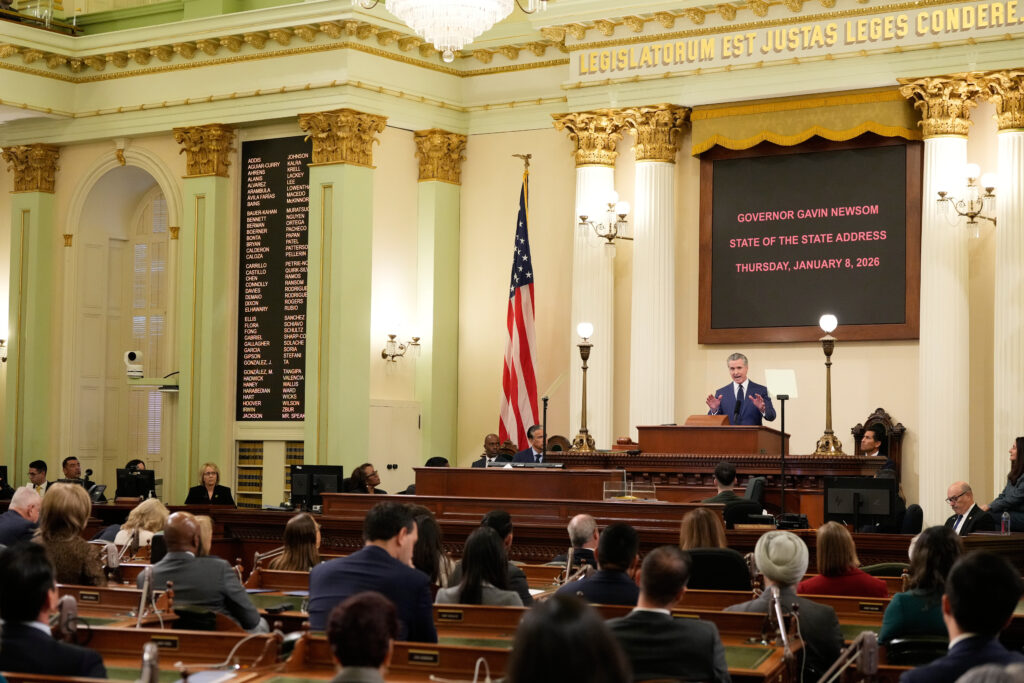
Gov. Gavin Newsom, above right, speaks during his final State of the State address on Jan. 8, 2026, in Sacramento.
Credit: Godofredo A. Vásquez / AP Photo
Top Takeaways
- Gov. Gavin Newsom projects revenues for 2026-27 that are at least $42 billion higher than what was previously forecasted.
- Newsom says his budget will support and expand signature programs, including funding more community schools and expanding after-school and summer school programs.
- The governor’s office will unveil his proposed budget on Friday.
Gov. Gavin Newsom offered a sunnier than expected forecast for the 2026-27 budget, which he says is good news for California schools. That means more stable funding for his signature education programs, including after-school and summer programs, universal transitional kindergarten, and community schools.
Newsom said the proposed budget is $42.5 billion more than was forecast, a “windfall” that does not include nearly $3 billion from December projections. His proposed budget projects $248.3 billion in total revenue for the general fund. Proposition 98, a constitutional amendment four decades ago, guarantees that about 40% of that total must go to TK-12 schools and community colleges.
“I’m proud to submit a budget tomorrow that has the most significant investments in California’s education history,” he said.
The governor shared a preview of his proposed budget on Thursday during a State of the State address to the state Legislature. His speech outlined his budget and legislative proposals in broad strokes; the governor’s office is expected to provide specific details of the budget on Friday.
Newsom said that Friday’s budget presentation will address long-term structural challenges. Recent budgets were balanced through accounting maneuvers, such as suspensions and deferrals. California’s budget is often volatile because it is subject to the whims of the stock market and the wealthy. Right now, the boom in artificial intelligence investment has driven surging incomes and stock prices that have strengthened budget revenue projections.
Newsom painted a gloomier picture of how President Donald Trump’s administration is affecting families both inside and outside schools, noting that the administration has recently frozen funding for child care and Temporary Assistance for Needy Families, or TANF. Newsom called the cuts “illegal” and said they were pointed at blue states that didn’t vote for Trump.
“They’re gonna throw parents into total disarray, forcing them to choose between going to work or taking care of their children,” he said.
As expected, one of Newsom’s biggest announcements was about the shift in the control of the California Department of Education from the elected state superintendent of public instruction to the governor and the State Board of Education.
“I think it’s time to modernize the management of our educational system,” he said.
Newsom’s proposed budget includes $27,418 per TK-12 student, an amount he said is enough to continue his commitment to transitional kindergarten, which completed its long-planned expansion to include all 4-year-olds this fall, with smaller class sizes.
The California School Boards Association has tussled in court over Prop. 98 funding, but CSBA spokesperson Troy Flint said this budget year looks more promising.
“We are cautiously optimistic, based on recent revenue reports, but it still will be a difficult budget given state and national developments,” Flint said. “We have been at odds with the Department of Finance based on what we considered recent attempts to sidestep the Proposition 98 obligations, but we are hopeful with more encouraging revenue developments that should not be an issue in 2026-27.”
Newsom pledged to expand after-school and summer school programs, which extend the learning day and provide child care for working families, to every elementary school in the state.
In recent years, California has expanded these programs to school districts where at least 75% of students were socioeconomically disadvantaged, English learners or foster youth, but during the last budget cycle, that threshold was lowered to 55%.
“That’s after-school for all,” he said. “We did it.”
Newsom pledged an additional $1 billion for “life-changing, enriching” community schools. These schools typically offer wraparound services that traditional schools don’t, addressing the basic needs in low-income communities. The state has so far invested $4.1 billion to support nearly 2,500 campuses — roughly 1 in 4 schools. The proposed budget aims to expand the number of schools included in the program.
Newsom championed California’s move to limit cellphone use in public schools, but he asked whether it was enough. He pointed to Australia, which recently moved to ban children under 18 from major social media platforms. Newsom said that boys and young men, especially, are struggling with social isolation, depression, and even radicalization.
“Our kids are increasingly more anxious, more addicted, less free, less happy because so much of their lives has lived online,” he said. “So much of their lives have become performative, measured by external validation, likes and followers. We’re watching the spiritual health of our young people erode, quite literally erode in real time.”
Newsom said little about the University of California or California State University systems. Neither is guaranteed minimum funding the way TK-12 schools and community colleges are; higher education systems must compete with other budget priorities, such as health care.